[ FISH ]

CLOWNFISH - DOTTYBACKS - GOBIES & BLENNIES - CARDINALFISH - SEAHORSES - OTHERS

SEAHORSES (Family: Sygnathidae)

A new era of captive care of seahorses has dawned with the introduction of aquacultured seahorses from ORA™. The wild-caught seahorses available in the past were notoriously difficult to feed and care for in aquariums. Even the most experienced aquarist had difficulty providing the live foods necessary every day to maintain them. There were also a number of seahorse related diseases that proved very difficult to cure. All of these difficulties have been overcome, and the danger of extinction diminished, with the successful breeding, rearing and frozen-food training of these incredible and lovable creatures.

Recently all Seahorses were placed on the Appendix II list of endangered species by CITES (Convention for the International Trade in Endangered Species). This severely restricts the legal import and export of seahorses, dead or alive. This is a welcome measure for seahorse conservation worldwide, and has nearly eliminated the wild seahorses available in the aquarium trade.

In nature most seahorses are found in the lagoons and grass flats inside the reef. Because of this environment, seahorses may encounter larger variations in water temperature and salinity. Seahorses may adapt to a wider range of water conditions than the reef fish commonly kept in aquariums. ORA™ seahorses are typically raised at a specific gravity of 1.020-1.023 and temperatures range from 75-85 degrees. All the seahorses raised at ORA™ are of the tropical variety, not the cold-water (temperate) species.

The greatest advance in seahorse keeping has been the ability to train the juvenile captive-bred animals to eat frozen mysis shrimp. With few exceptions, wild seahorses would eat only live foods. Now that they can be taught at an early age to accept frozen food, one of the biggest obstacles in caring for them has been overcome. Seahorses should be fed defrosted mysis two or three times a day. As the frozen shrimp are moved around by the current in the tank, the seahorses will respond and chase and eat them. If the food hits the bottom and is trapped by decor, the seahorses may not find it and the decaying shrimp can foul water quality. It is important to set up the seahorse display so that a sweeping current flows across the bottom, and un-eaten food is not trapped.

Seahorses should not be kept with other fish as tankmates. This is due to the fact that they cannot compete with the fast moving fish for food. They are best kept in a small (10-20 gallon) aquarium by themselves. Of course they will need some "Seahorse Trees" such as artificial branching coral, gorgonians, or other objects to latch onto with their prehensile tails.

The common types of parasites and disease usually associated with aquarium fish do not affect seahorses. They are susceptible to a number of diseases specific to seahorses. In wild-caught seahorses the stress of capture, transport and starvation in captivity caused disease and death. The aquacultured seahorse is not exposed to these stressful conditions, and diseases are much less common.

With the right aquarium set-up, proper feeding and care, aquacultured seahorse may live for many years. Average age for many of the tropical seahorses is about 4-6 years. They will reach sexual maturity as early as 4 months, and pairs will readily spawn in aquariums. Seahorse reproduction is well known for having the male give birth to live young. Fertilization actually takes place in the female and then she passes the fertile eggs into the male pouch where they develop for two to four weeks, and are eventually released. Typically 50 to 150 juveniles may be born over the course of many hours.

Raising newborn seahorses presents many difficulties, including the necessity of using large amounts of live food. Unless very well prepared, most hobbyists would not be able to rear the young properly. Sometimes it is better to keep two males or two females in order to avoid the inevitable situation of watching the juveniles perish. The smooth brood pouch present in the male can easily distinguish males from females.

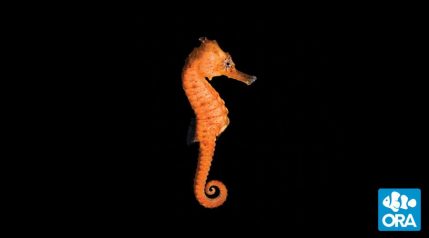
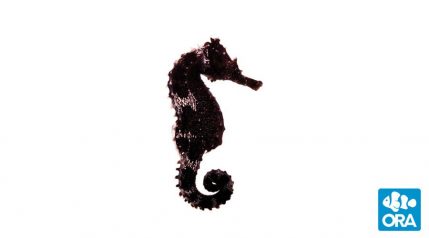
Seahorse may change color with mood, water quality or color of the aquarium background. Colored seahorses may turn black, or vice versa, as they try and match their environment. Changing the aquarium décor, water changes and eliminating stressful conditions may affect the color they display.

SEAHORSES SPECIES AVAILABLE FROM ORA™


Zebra-snout Seahorse - Hippocampus barbouri

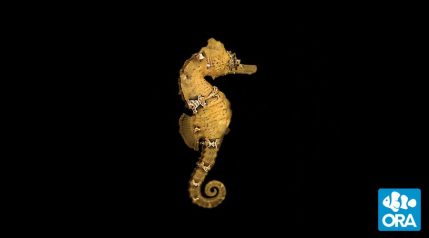
The natural habitat of the Zebra-snout Seahorse is the waters of the Philippines, northern Indonesia and likely Japan. This seahorse is easily recognizable by its striped snout, spiny coronet, double-cheek spines and one thick spine on the snout in front of the eyes. The striped pattern continues around each eye. ORA's Zebra-snout seahorses are predominantly yellow with reddish brown spots, though stress or environmental changes may cause them to darken to a pale brown. They reach an average height of 5.9 inches (15 cm).

Zebra-snout Seahorses are found at depths of 6-10 m often clinging to hard coral. They seem undisturbed by the corals' stingers, making them the only known reef-compatible seahorse species. H. barbouri thrive in groups and would make an excellent addition to a small-polyp stony coral tank.


Short-snout Seahorse - Hippocampus breviceps

The Short-snout Seahorse is found off Australia's coast and in locations throughout the Indo-Pacific at a depth of up to 15 m. The seahorses' wide distribution from temperate to cool waters has led to a reputation of being a cool water species. However, ORA™ cultures the Short-snout Seahorse at the same water temperature as our other tropical species. The seahorses not only survive in warm water; they successfully spawn.

The Short-snout Seahorse is identified by its short snout and long, irregular appendages on the head and back. Coloration is typically yellow with brown and white spots. This species does well in small groups. They reach a maximum size of nearly 4 inches (10cm).


Tiger-Tail Seahorse - Hippocampus comes

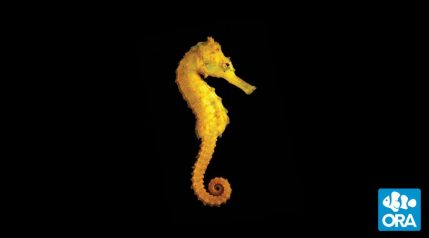
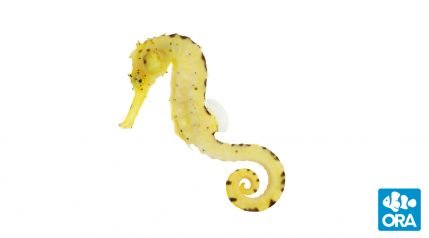
This industry-first species was raised in 2007 at ORA™. This reef-dwelling seahorse inhabits tropical waters around Malaysia and Singapore and as far east as the Philippines. Their preferred habitat is among soft corals at depths from 15 to 50 ft. They are a bold yellow coloration and exhibit striking, tiger-like rings on their tails. The maximum height of this seahorse is about 6 inches.

This very hardy seahorse would make a great addition to any reef tank. They especially prefer finger and toadstool leather corals, gorgonians, and sponges.


Dwarf Seahorse - Hippocampus zosterae

This species is found in tropical waters of the Atlantic Ocean and the Gulf of Mexico. As its name implies, this seahorse reaches a maximum size of less than 2 inches.

It is found mostly in seagrass beds. They can range in color from yellow to black.

The Dwarf Seahorse's small size makes it ideal for nano tanks. Groups of 5 or more can be kept in tanks as small as 10 gallons. This seahorse is sold at 1 inch and is weaned onto frozen diets.


Yellow Kuda Seahorse - Hippocampus kuda

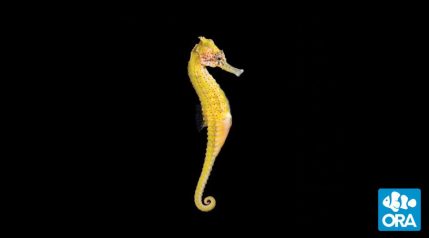
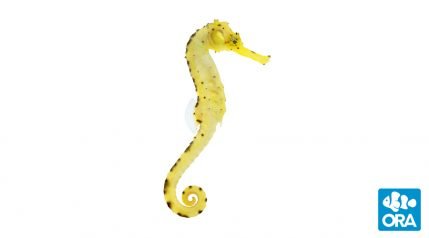
ORA™ is presently culturing an Indo-Pacific species of seahorse known as Hippocampus kuda. There is some debate as to the classification of seahorses and H. kuda may represent more than one type. This species can range in color from black to yellow and orange. The may also be black with silver bars or other markings on the body. Yellow Kudas are a slender-bodied seahorse, and live in shallow grass flats, lagoons, and bays

ORA™ selectively breeds this species to display the yellow color form. They are much less likely to change color, although under certain condition they may darken. They are ready for sale at about 2 _ inches in size, which is close to the sexually mature age. They will grow to about 6 inches maximum size.


Brazilian Seahorse - Hippocampus reidi

Brazilian Seahorses are actually an Atlantic species with a wide range. They occur from as far north the Carolinas, Bermuda and south to Brazil. They are known in the hobby as Brazilian Seahorses because in the past many colorful wild specimens were imported form Brazil.

The Brazilian variety of H. reidi is one of the largest seahorses species known, growing to over 8 inches in length. They have a range of color variations from black to yellow, orange and red. ORA™ currently aquacultures the black and yellow varieties.


OTHER SEHORSE SPECIES

ORA™ has bred a number of other seahorse species in the last few years. They are available occasionally in limited quantities. Seahorse species successfully bred at ORA™ include:

Lined Seahorse - Hippocampus erectus

© 2009, Oceans, Reefs & Aquariums Inc.