[ MISSION - FAQ'S ]

The mission of ORA is to research and produce, through aquaculture, species of saltwater fish and invertebrates for the marine aquarium trade. ORA is committed to providing the modern marine aquarist healthy and attractive alternatives to wild caught specimens. ORA aquacultured species help conserve coral reefs and gives aquarium hobbyists a better chance of success.

Ultimately our goal is to provide all of the fish and invertebrates necessary to stock a beautiful marine reef aquarium without the need to rely on natural resources. We believe the all-aquacultured aquarium is the aquarium of the future, and ORA is leading the way.


FAQ's (Frequently Asked Questions)

- Does ORA Receive Government Funding For Their Research?
No. ORA has never received government funding for their research. ORA is a wholly-owed for-profit subsidiary of Harbor Branch Holdings, Inc. The ORA mission is to provide the pet industry - and the environmentally-conscious hobbyist - with quality aquacultured products.

- Can farm-raised clownfish associate with anemones?
One popular misconception is that tank-raised clownfish will not symbiotically associate with anemones. This is absolutely not true as demonstrated by the many hobbyists who report tank-raised clowns associating with anemones in home tanks. The behavior appears to be instinctive, and cannot be "bred-out", nor do the young need to "learn" this behavior from their parents.

We have found that Entacmea quadricolor, the bubble-tip anemone, is one of the easiest Pacific anemones to keep in an aquarium, and many species of clownfish will associate with it. There are also numerous reports form aquarists that tank-raised clownfish have associated with unusual hosts such as Condylactis anemones from the Caribbean, the tentacles of long-polyp stony corals, and even Mushroom anemones.

- What's the Difference Between True Percula Clownfish and False Percula Clownfish?
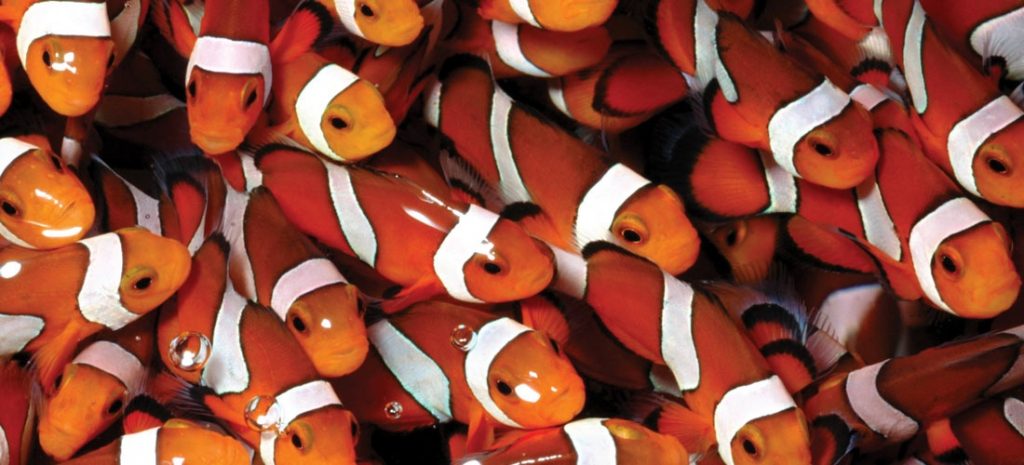
True Percula Clownfish (Amphiprion percula) is a species from the Indo-Pacific region. There is quite a bit of variation in markings among individuals. A. percula have three white bars. As adults, the bars are often bordered in black, which varies in width. In some individuals it may extend from margin to margin replacing quite a bit of the orange color. The middle bar normally has a forward projection.

The true perculas have 11 dorsal spines compared to the Ocellaris who usually have have 10 dorsal spines.

The two species do not have overlapping distributions. A. percula are found in Northern Queensland and Melanesia, while A. ocellaris are found in the Andaman sea, the Indo-Malayan Archipelago, Philippines, northwestern Australia, coast of southeast Asia northward to the Ryukyu Islands.

ORA sells True Perculas at approximately 8 - 9 months of age, which is before adult coloration is complete. Once fish are placed in a reef aquarium with strong lighting, the coloration usually develops more black patterns. Some aquarists believe associations with anemones can influence coloration as well.

False Percula Clownfish- (Amphiprion ocellaris) - Generally, most False Perculas are bright orange with 3 complete white stripes. A black line borders these stripes. A.ocellaris does not have a thick black margin around the white bars like True Perculas usually do.

Both species are easy to keep in aquariums. They prefer the carpet anemones as host species, usually H. magnifica, S. gigantea , S. mertensii or S. haddoni. H. magnifica and S. gigantea are extremely difficult to keep, so S. mertensii or S. haddoni are preferred for aquariums

- What are Misbars ?
Misbars are simply normal, healthy fish with incomplete stripes. The headbar, midbar or tailbar may be affected. Although some people consider mis-barring to be an imperfection, many people love the unique markings of mis-barred fish. Lots of our customers specifically request them.

The exact cause of misbarred fish is unknown, however it is believed that there is a certain percentage of naturally occurring incomplete striping. Since a high percentage of each spawn survives to maturity in aquaculture, a higher percentage of misbars are seen.

The Teardrop Melanopus is one example of interesting misbarring. The incomplete head bar results in "tear drop" markings on the face.

- What Are Stubbies?
Occasionally we will discover dwarf fish in the production tanks. We call them "Stubbies." These perfectly healthy but admittedly deformed fish usually don't reach full size. Many people consider them as defective but some people (including certain sales staff members) absolutely adore them. It is thought that these fish are born lacking the usual number of vertebrate in the spine, giving them a short body. Limited quantities are usually available.

- Why Do The Gold Stripe Maroons Have White Stripes?
At the present time we are only selling Gold Stripe Maroons. Because we sell them at approximately 8 or 9 months of age, they are still juveniles and have not yet developed the gold in their stripes. Usually the gold will begin to appear around 11 or 12 months of age.

- Can Anyone Order from ORA?
Sorry but no. ORA can only sell to retail Aquarium and Pet Stores.

- So How Can I Get ORA Fish?
Ask your regular pet store to order what you want. If they do not have an account with us we can set one up with them. You can also call us at 772-468-7008 and we will be happy to help you find a store in your area that carries our fish.

- What Temperature Do You Recommend?
75-80 degrees Fahrenheit is ideal.

- What Salinity Do You Recommend?
1.019-1.023 specific gravity is the recommended range.

- What pH Do You Recommend?
8.0 - 8.2.

- What Lighting do you recommend for Corals?
We recommend a minimum of 4 watts per gallon for most corals. High Output florescent, Power Compacts and Metal Halide lighting systems all are capable of supporting coral growth. ORA supplements indirect sunlight with 250 watt, 10,000K double ended HQI Metal Halide lighting to grow our coral frags.

- Lighting for Fish?
Fish are not as dependent on light as photosynthetic invertebrates are. Normal wattage aquarium bulbs are adequate to illuminate a fish only system.

- What's the Difference Between a Fighting Conch and a Queen Conch?
Fighting conchs (Strombus alatus) have white and brown shells. Since fighting conchs eat brown diatoms and other algae on the surface of live sand beds, they stir and clean upper layers.

Queen conchs, Strombus gigas, have gray shells and are algae eaters. They graze algae on live rock and even off the glass. They will also consume detritus on the sand bed.

- Why do they call them Fighting Conch?
The common name Fighting Conch refers to the male ritual of fighting each other with their proboscis at mating time. They do not fight with other animals and are quite docile in aquariums. They are reef safe for corals and clams.

- Can you put Fighting Conchs and Queen Conchs together?
Yes. They have different jobs and they coexist well.

- Do farm-raised fish adjust to aquarium life better than wild-caught fish?
ORA fish have a positive association with people. If you walk down one of the aisles in the hatchery the fish actually bob their heads out of the water, expecting to be fed. We can assure hobbyists that ORA fish adjust to life in captivity better than wild fish, and will hide less and interact more. The fish are raised on prepared foods, much like home aquarist provide. There is no need for them to adapt from a life in the wild to captivity.

- Which fish get along well together?
There are many factors that affect what fish will cohabitate peacefully. Aquarium size, rock or artificial structures and age of existing fish all contribute to compatibility.

You can generally depend on the gobies to co-exist well with other fish.

It is usually difficult to get two species of Clownfish established in the same tank unless it is a very large tank. In terms of most aggressive to least aggressive, clownfish can be rated by species as Maroon - Tomato - Clarkii - Skunk - Percula - Ocellaris.

The Dottybacks are territorial and will defend their territory from other Dottybacks. Adding all Pseudochromids at the same time and having a large tank with plenty of hiding spaces may help establish more than one Dottyback in a community tank.

© 2007, Harbor Branch Oceanographic Institution